68 NiuNiu Hand Type Quick Reference
68 NiuNiu hand types are an important basis for determining the size comparison between banker and player. After grabbing a TNG red packet, besides calculating the points corresponding to the amount, you also need to first check whether the digits form a special hand type. The current special hand types, from highest to lowest, are Triple, Full Bull, Reverse Straight, Straight, Pair, and Golden Bull, corresponding to 18x down to 11x; when a hand type is formed it is compared first, and regular points are only compared when neither side has a special hand type.
- 1. 68 牛牛 Hand Type Ranking Order
- 2. Triple: Three Identical Digits
- 3. Full Bull: Red Packet Amount Is an Integer
- 4. Reverse Straight: Digits Decrease Continuously
- 5. Straight: Digits Increase Continuously
- 6. Pair: Last Two Digits Are the Same
- 7. Golden Bull: Red Packet Amount Starts and Ends with 0
- 8. How Are Hand Types Compared with Regular Points?
- 9. 68 牛牛 Hand Type FAQ
68 NiuNiu Hand Type Ranking Order
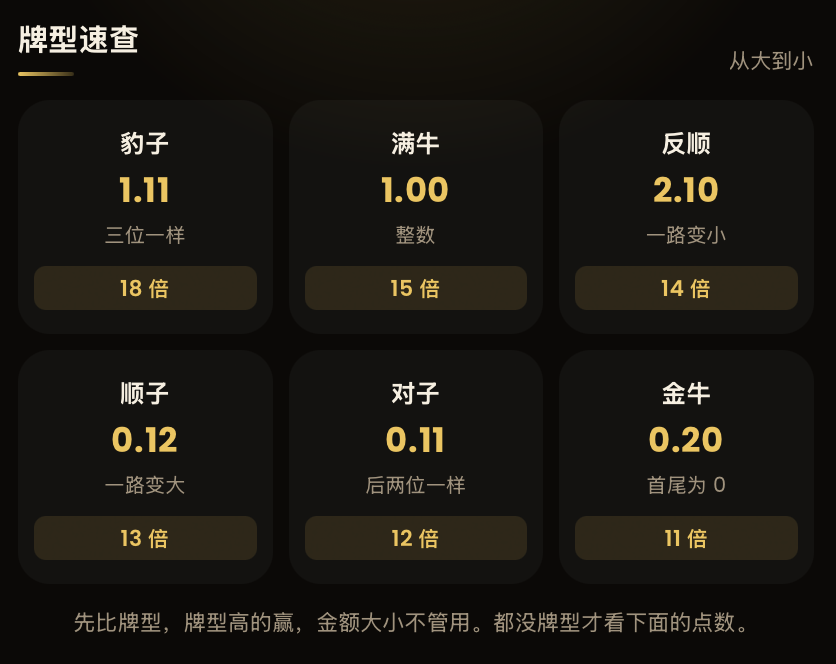
68 NiuNiu special hand types are compared in a fixed order, from highest to lowest: Triple > Full Bull > Reverse Straight > Straight > Pair > Golden Bull. The corresponding multipliers are 18x, 15x, 14x, 13x, 12x, and 11x respectively. As long as a special hand type is formed, the size is judged first by hand type rank.
Hand type ranking and multiplier quick reference
Triple is the highest hand type, corresponding to 18x; Full Bull is 15x; Reverse Straight is 14x; Straight is 13x; Pair is 12x; Golden Bull is 11x. All six special hand types have clear identification methods, so after grabbing a red packet, you can first look at the digit combination and then decide whether regular points need to be calculated.
Why check the hand type first?
The current rules clearly adopt a "compare hand type first" approach. As long as a special hand type appears, it should be judged first by hand type rank rather than by regular points.
Triple: Three Identical Digits
How is Triple determined?
When the three digits of the red packet amount used to determine the hand type are completely identical, it forms a Triple. For example, the digits of RM1.11 are 1, 1, and 1, all three identical, so it is a Triple.
What multiplier is Triple?
Triple corresponds to 18x, making it the highest-ranked and highest-multiplier hand type among the current six special hand types.
Triple example: RM1.11
All three digits of RM1.11 are 1, meeting the "three identical digits" condition, so it is identified as a Triple rather than being compared by regular points.
Full Bull: Red Packet Amount Is an Integer
How is Full Bull determined?
The identification condition for Full Bull is that the red packet amount is an integer, meaning the amount has no decimal remainder. For example, RM1.00 meets the integer amount condition, so it is a Full Bull.
What multiplier is Full Bull?
Full Bull corresponds to 15x and ranks second only to Triple in the hand type order, higher than Reverse Straight, Straight, Pair, and Golden Bull.
Full Bull example: RM1.00
RM1.00 is a complete integer amount, so it is identified as Full Bull according to the current hand type rules and compared according to the Full Bull hand type rank.
Reverse Straight: Digits Decrease Continuously
How is Reverse Straight determined?
When the digits of the red packet amount are arranged in a continuously decreasing manner, that is, the digits decrease continuously, it is a Reverse Straight. For example, the digits of RM2.10 are 2, 1, and 0 in sequence, forming a continuously decreasing combination.
What multiplier is Reverse Straight?
Reverse Straight corresponds to 14x, with a hand type rank lower than Triple and Full Bull but higher than Straight, Pair, and Golden Bull.
Reverse Straight example: RM2.10
The digits of RM2.10 go from 2 to 1, then from 1 to 0, continuously decreasing, so it meets the Reverse Straight identification method.
Straight: Digits Increase Continuously
How is Straight determined?
When the digits in the red packet amount are arranged in a continuously increasing manner, that is, the digits increase continuously, it forms a Straight. For example, the digits of RM0.12 are 0, 1, and 2 in sequence, forming a continuously increasing combination.
What multiplier is Straight?
Straight corresponds to 13x and ranks after Reverse Straight in the current hand type ranking, higher than Pair and Golden Bull.
Straight example: RM0.12
The digits of RM0.12 increase continuously as 0, 1, and 2, so it meets the "continuously increasing" condition and can be identified as a Straight.
Pair: Last Two Digits Are the Same
How is Pair determined?
When the last two digits of the red packet amount are the same, it meets the basic identification condition for a Pair. For example, the last two digits of RM0.11 are both 1, so it forms a Pair.
What multiplier is Pair?
Pair corresponds to 12x, with a hand type rank lower than Straight but higher than Golden Bull.
Pair example: RM0.11
The last two digits of RM0.11 are 1 and 1, both the same, so it is identified as a Pair.
How are two Pairs compared?
When both the banker and the player form a Pair, the pair digit formed by the last two digits is compared first, for example, 88 is greater than 66; if further judgment is still needed, the corresponding points and actual rules are then combined to complete the comparison.
Golden Bull: Red Packet Amount Starts and Ends with 0
How is Golden Bull determined?
The identification condition for Golden Bull is that the red packet digits used for judgment start and end with 0. For example, the first and last digits of RM0.20 are both 0, so it meets the Golden Bull condition.
What multiplier is Golden Bull?
Golden Bull corresponds to 11x, the last rank among the current six special hand types, but it is still a special hand type and should be judged first by hand type rules when compared with regular hands.
Golden Bull example: RM0.20
The digits of RM0.20 are 0, 2, and 0, with the first and last both being 0, so it is identified as a Golden Bull.
| Hand Type | Points / Feature | Multiplier |
|---|---|---|
| Triple | 1.11|Three identical digits | 18x |
| Full Bull | 1.00|Integer | 15x |
| Reverse Straight | 2.10|Continuously decreasing | 14x |
| Straight | 0.12|Continuously increasing | 13x |
| Pair | 0.11|Last two digits identical | 12x |
| Golden Bull | 0.20|Starts and ends with 0 | 11x |
How Are Hand Types Compared with Regular Points?
Step 1: First determine whether there is a special hand type
After grabbing a red packet, first check whether the amount digits meet the conditions for Triple, Full Bull, Reverse Straight, Straight, Pair, or Golden Bull. As long as a special hand type is formed, it enters hand type comparison.
Step 2: If there is a hand type, compare hand types first
When both sides have special hand types, judge according to the rank order of Triple > Full Bull > Reverse Straight > Straight > Pair > Golden Bull. The side with the higher hand type rank wins, so it cannot be judged simply by red packet amount or regular points.
Step 3: Only look at points when neither has a hand type
If neither the banker nor the player has formed a special hand type, it enters regular point comparison. Regular points require adding the individual digits in the red packet amount and taking the ones digit, where a ones digit of 0 is calculated as the highest 10-point NiuNiu.
Can the red packet amount size directly decide the win or loss?
No. The current rules clearly state that when the side with the higher hand type wins, the amount size is not used as the priority basis for judgment; when neither side has a special hand type, the regular points below are checked. Therefore, you cannot simply compare the RM amount size of two red packets.
68 NiuNiu Hand Type FAQ
What special hand types does 68 NiuNiu have?
The current special hand types are six: Triple, Full Bull, Reverse Straight, Straight, Pair, and Golden Bull.
What is the highest hand type in 68 NiuNiu?
Triple is the current highest hand type, corresponding to 18x, and its identification condition is three identical digits.
How are 68 NiuNiu hand types ranked from highest to lowest?
From highest to lowest, they are Triple, Full Bull, Reverse Straight, Straight, Pair, and Golden Bull, corresponding to 18x, 15x, 14x, 13x, 12x, and 11x.
What hand type is RM1.00?
RM1.00 is an integer amount and, according to the current rules, is a Full Bull, corresponding to 15x.
What hand type is RM2.10?
The digits of RM2.10 are 2, 1, and 0, arranged in continuously decreasing order, so it is a Reverse Straight, corresponding to 14x.
What hand type is RM0.12?
The digits of RM0.12 are 0, 1, and 2, continuously increasing, so it is a Straight, corresponding to 13x.
What hand type is RM0.11?
The last two digits of RM0.11 are the same, so it is a Pair, corresponding to 12x.
What hand type is RM0.20?
The first and last digits of RM0.20 are both 0, so it is a Golden Bull, corresponding to 11x.
If there is a special hand type, do I still need to compare regular points first?
No, regular points do not need to be compared first. The current rules compare hand types first, and the side with the higher hand type takes priority; only when neither side has a special hand type does it enter regular point comparison.
After Mastering Hand Types, Continue Learning About Points and Multipliers
After becoming familiar with Triple, Full Bull, Reverse Straight, Straight, Pair, and Golden Bull, you can continue to view the regular points and multiplier rules to further understand how banker-player size comparison is calculated.