68 NiuNiu How Many Points Equal How Many Times the Multiplier?
How many points equal how many times the multiplier in 68 NiuNiu? When a red packet does not form a special hand type, regular hands use a multiplier matching the calculated points: 1 point is 1x, 2 points is 2x, and so on up to 9 points being 9x, while the highest 10-point NiuNiu corresponds to 10x. When comparing the size of two regular hands, points are also compared first, with the higher points winning, so mastering "however many points, that many times the multiplier" lets you quickly understand the multiplier rule for regular hands.
- 1. 68 牛牛 How Many Points Equal How Many Times the Multiplier?
- 2. How Many Times the Multiplier Are 1 to 10 Points Respectively?
- 3. Why Does 10-Point NiuNiu Count as 10x?
- 4. How Are Regular Hand Points and Multipliers Calculated?
- 5. How Is Size Compared When Both Sides Have Regular Hands?
- 6. What Is the Difference Between Special Hand Types and Regular Point Multipliers?
- 7. 68 牛牛 Point Multiplier FAQ
68 NiuNiu How Many Points Equal How Many Times the Multiplier?
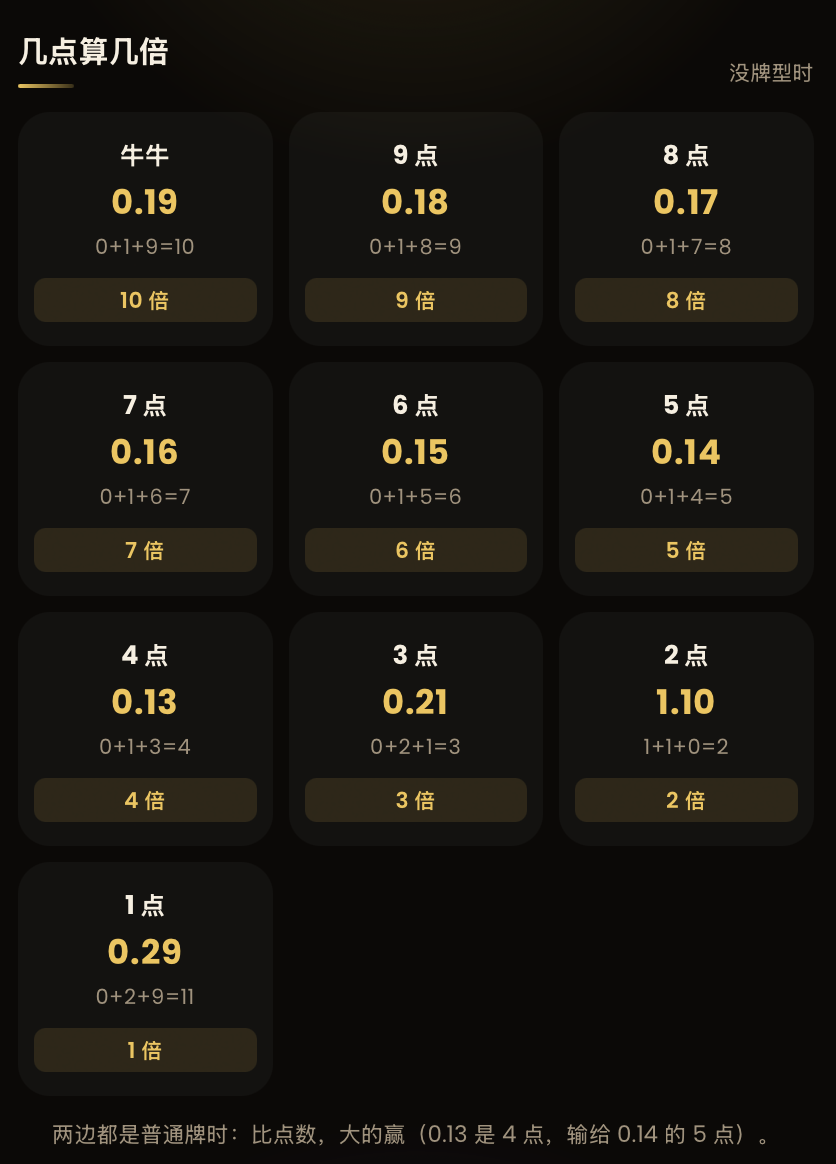
When there is no special hand type, 68 NiuNiu uses the regular hand multiplier rule of "however many points, that many times the multiplier." If 1 point is calculated, it is 1x; 5 points is 5x; 9 points is 9x; if the ones digit after adding the amount digits is 0, it is treated as the highest 10-point NiuNiu, corresponding to 10x.
How to remember regular hand multipliers?
The simplest way is to remember "points = multiplier." Regular hands go from 1 to 10 points, and the corresponding multipliers also go from 1x to 10x, without needing another multiplier conversion method.
Which regular point has the highest multiplier?
10-point NiuNiu is the highest tier among regular points, corresponding to 10x. 9 points corresponds to 9x, 8 points to 8x, and so on decreasing to 1 point corresponding to 1x.
How Many Times the Multiplier Are 1 to 10 Points Respectively?
10-point NiuNiu: 10x
10-point NiuNiu corresponds to 10x. For example, the digits of RM0.19 are calculated as 0+1+9=10, with a ones digit of 0, so according to the rules it is calculated as 10-point NiuNiu, corresponding to 10x.
9 points: 9x
9 points corresponds to 9x. For example, the digits of RM0.18 add up to 0+1+8=9, so it is 9 points, corresponding to 9x.
8 points: 8x
8 points corresponds to 8x. For example, RM0.17 is calculated as 0+1+7=8, so it is 8 points, corresponding to 8x.
7 points: 7x
7 points corresponds to 7x. For example, the digits of RM0.16 add up to 0+1+6=7, so it is 7 points, corresponding to 7x.
6 points: 6x
6 points corresponds to 6x. For example, RM0.15 is calculated as 0+1+5=6, so it is 6 points, corresponding to 6x.
5 points: 5x
5 points corresponds to 5x. For example, the digits of RM0.14 add up to 0+1+4=5, so it is 5 points, corresponding to 5x.
4 points: 4x
4 points corresponds to 4x. For example, the digits of RM0.13 add up to 0+1+3=4, so it is 4 points, corresponding to 4x.
3 points: 3x
3 points corresponds to 3x. For example, the digits of RM0.21 add up to 0+2+1=3, so it is 3 points, corresponding to 3x.
2 points: 2x
2 points corresponds to 2x. For example, the digits of RM1.10 add up to 1+1+0=2, so it is 2 points, corresponding to 2x.
1 point: 1x
1 point corresponds to 1x. For example, the digits of RM0.29 add up to 0+2+9=11, and only the ones digit 1 of the result is taken, so it is 1 point, corresponding to 1x.
| Points | Example | Calculation | Multiplier |
|---|---|---|---|
| NiuNiu | 0.19 | 0 + 1 + 9 = 10 | 10x |
| 9 points | 0.18 | 0 + 1 + 8 = 9 | 9x |
| 8 points | 0.17 | 0 + 1 + 7 = 8 | 8x |
| 7 points | 0.16 | 0 + 1 + 6 = 7 | 7x |
| 6 points | 0.15 | 0 + 1 + 5 = 6 | 6x |
| 5 points | 0.14 | 0 + 1 + 4 = 5 | 5x |
| 4 points | 0.13 | 0 + 1 + 3 = 4 | 4x |
| 3 points | 0.21 | 0 + 2 + 1 = 3 | 3x |
| 2 points | 1.1 | 1 + 1 + 0 = 2 | 2x |
| 1 point | 0.29 | 0 + 2 + 9 = 11 | 1x |
Why Does 10-Point NiuNiu Count as 10x?
When the ones digit is 0, it is calculated as 10 points
Point calculation requires adding the individual digits of the red packet amount and then checking the ones digit of the result. When the ones digit of the sum is 0, it is not treated as 0 points but is calculated as the highest 10-point NiuNiu.
10 points corresponds to the highest regular hand multiplier
Since regular hands use the rule that however many points corresponds to that many times the multiplier, 10-point NiuNiu naturally corresponds to 10x, which is also the highest multiplier within the regular point range.
Why is RM0.19 10x?
The digits of RM0.19 add up to 0+1+9=10. The ones digit of the calculation result is 0, so it is converted to 10-point NiuNiu; 10 points corresponds to 10x, so RM0.19 is judged at 10x when there is no other special hand type affecting it.
How Are Regular Hand Points and Multipliers Calculated?
Step 1: First confirm there is no special hand type
Before calculating regular point multipliers, you should first check whether the red packet amount forms a special hand type such as Triple, Full Bull, Reverse Straight, Straight, Pair, or Golden Bull. If a special hand type has already been formed, it should be handled according to the corresponding hand type rules.
Step 2: Add the red packet amount digits
If no special hand type is formed, add each digit in the red packet amount. For example, RM0.17 can be calculated as 0+1+7=8.
Step 3: Take the ones digit of the calculation result
After adding the digits, check the ones digit of the result, and that digit is the regular hand points. For example, if the sum is 11, the ones digit 1 is taken, so it is calculated as 1 point.
Step 4: Determine the multiplier according to the points
After confirming the points, the multiplier can be obtained directly. For example, 8 points corresponds to 8x, 4 points to 4x, and 1 point to 1x; if the ones digit is 0, it is calculated as 10-point NiuNiu, corresponding to 10x.
How Is Size Compared When Both Sides Have Regular Hands?
Regular hands compare points directly
When neither the banker nor the player has formed a special hand type, the respective calculated regular points are compared. The side with more points wins, for example, 5 points is greater than 4 points, so the side with 5 points wins.
How are RM0.13 and RM0.14 compared?
The digits of RM0.13 add up to 0+1+3=4, so it is 4 points; RM0.14 is 0+1+4=5, so it is 5 points. When both sides have regular hands, 5 points is greater than 4 points, so RM0.14 beats RM0.13.
Is the red packet amount compared directly?
No. Regular hands compare the points obtained after calculating the amount digits, not the RM amount itself directly. For example, a red packet amount that looks larger does not necessarily mean its calculated points will be higher.
What Is the Difference Between Special Hand Types and Regular Point Multipliers?
Special hand types have independent multipliers
Special hand types do not use the regular hand multiplier range of 1 to 10 points. Currently, Triple is 18x, Full Bull 15x, Reverse Straight 14x, Straight 13x, Pair 12x, and Golden Bull 11x.
Special hand types take priority over regular points
When comparing, hand types should be checked first. When a special hand type appears, judgment is made first by hand type rank; only when neither side has a special hand type are the regular hand 1 to 10 points and corresponding multipliers used for comparison.
How to understand the complete multiplier range?
Regular hands correspond to 1x to 10x, while special hand types start from Golden Bull at 11x, followed by Pair at 12x, Straight at 13x, Reverse Straight at 14x, Full Bull at 15x, and Triple at 18x.
68 NiuNiu Point Multiplier FAQ
How many times the multiplier is 1 point in 68 NiuNiu?
1 point corresponds to 1x. For example, the digits of RM0.29 add up to 11, and after taking the ones digit, 1 point is obtained, so it corresponds to 1x.
How many times the multiplier is 5 points?
5 points corresponds to 5x. Regular hands use the correspondence of "however many points, that many times the multiplier."
How many times the multiplier is 9 points?
9 points corresponds to 9x. For example, RM0.18 is calculated as 9 points, so it corresponds to 9x.
How many times the multiplier is 10-point NiuNiu?
10-point NiuNiu corresponds to 10x, which is the highest multiplier among regular points.
Is a sum of 11 equal to 11 points?
No. Points only look at the ones digit of the sum, so when the total is 11, the ones digit 1 is taken, and the final result is 1 point, corresponding to 1x.
If the ones digit of the sum is 0, how many times the multiplier is it?
When the ones digit is 0, it is calculated as 10-point NiuNiu, so it corresponds to 10x, not 0x.
How is win or loss judged when neither side has a hand type?
When both sides have regular hands, points are compared directly, and the side with more points wins. For example, when comparing 4 points and 5 points, 5 points wins.
Is Triple also 10x?
No. Triple is a special hand type, corresponding to 18x. The highest multiplier for regular hands is the 10x of 10-point NiuNiu.
View the Complete Hand Type and Multiplier Rules
After mastering the corresponding multipliers for regular hands from 1 to 10 points, you can continue to view the special hand types and multipliers of Triple, Full Bull, Reverse Straight, Straight, Pair, and Golden Bull. If you need to enter 68 NiuNiu, you can use the official Telegram entry: https://t.me/niuniu68_bot?start=6081936318